Showing posts with label birding. Show all posts

Wednesday, February 8, 2023

Accessible Birding in Winter

Thank you Meghadeepa, for sharing your personal experience and recommended strategies for birding with disabilities in winter!  This article is reprinted with permission from Bird Observer, February 2023, Volume 53, Number 1, www.birdobserver.org 

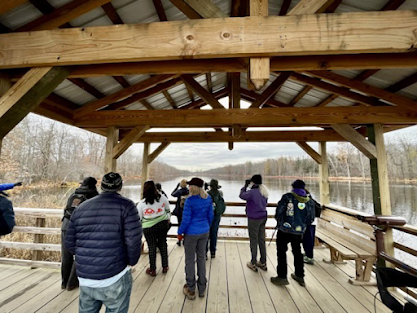
Birding from the accessible gazebo at Longmeadow Flats.
Photograph by Steph Almasi.

Many folks are content limiting their birding to the abundance of spring. Seems like a smart decision. I live in small-town and rural Massachusetts, where the climate can create dangerous outdoor conditions for the six months that we split between Thanksgiving blizzards, actual winter, and faux spring. Tall snowbanks block crosswalks and views. Parking lots that are plowed on a somewhat predictable schedule are unpredictably left unsalted. Black ice surreptitiously creeps up on you when you least expect it. And even on the most popular “accessible” birding trails and bike paths, you must fend for yourself once frozen precipitation hits the ground. When you get out the door, the subzero temperatures and wind chill will surely turn your limbs into ice. And these are just the barriers that nondisabled birders experience in northern winters.

Friday, March 25, 2022

Accessible Birding - and Anti-Racist Too!

A closed road side is an accessible birding
hotspot at a water treatment plant.
    Spring is emerging and birds are returning! Some of my favorite places to birdwatch are in Massachusetts State Parks. Accessible birding locations I enjoy include Belle Isle Marsh Reservation in E. Boston, the Norwottuck Rail Trail in Amherst/Hadley, and the Canalside Rail Trail in Turners Falls. In addition, I highly recommend Plum Island in Newburyport, Constitution Beach in E. Boston in winter, several ponds accessible via carriage roads in Borderland State Park, and Crosby Landing in Nickerson State Park on Cape Cod.

    As part of my job with the Massachusetts Department of Conservation and Recreation (DCR) Universal Access Program, I have fond memories of birding with people with disabilities back in 2005-2010 and developing techniques to help more people use optics. Some of these techniques included the use of a monopod with binoculars and starting new birders in places with easy-to-view birds like waterfowl and herons. With changes in technology since then, I'm sure more strategies have emerged for providing the best experience possible for birders with disabilities.

Wednesday, December 3, 2014

Checking out the Accessible Trail and Birds at Arcadia Wildlife Sanctuary


Cyndy Chamberland shares her recent process getting comfortable with birding outdoors on her own as a power wheelchair user. Without natural places that offer accessibly designed landscapes, this would not be possible for many people with physical disabilities. Thanks Cyndy for offering your experience to inspire others with disabilities to explore their local resources! Thanks Mass Audubon for your dedication to making nature accessible to all! 

Recently on a cool but sunny late morning I met up with my friend and former colleague, Marcy Marchello, at Arcadia Wildlife Sanctuary for a little birding expedition and to check out their accessible sensory trail. Arcadia is a Mass Audubon property practically in my own backyard.  It's located off the Manhan Rail Trail in Eastern Massachusetts.  Yet while it is so close, I have only ventured there just a few times in my twenty-something years living in Easthampton. Why is that?  Well for starters, as I am  quadriplegic and use a power wheelchair, so I am leery about going into the woods and on trails unless I am sure the trails are accessible.  It isn't pleasant when you find out that the trail or outdoor site has obstacles such as steps, boulders, logs, streams etc. that restrict wheelchair users and other persons with physical and visual disabilities from accessing the trails and area.  We don't always know if a place is accessible to us even when it is in our own neighborhood or town.

Friday, October 28, 2011

Big Beautiful Birds - An Accessible Michigan Outing

Just back from a family trip to Michigan and I am pleased to share a positive report on accessibility in my home state. My mom, brother and I took a trip 30 minutes west of Ann Arbor to the Waterloo Recreation Area in hopes of seeing Sandhill Cranes.

Sandhill Cranes are in migration right now, congregating in open fields and wetlands in south central Michigan to rest and fuel up on remnants of corn and grain left on the ground after harvesting, as well as a wide array of insects still kicking in these last days before deep frost. The land was once prairie, but now patches of forest dot the open country too. The 4 1/2 foot high cranes are easy to spot from your car (car birding being one of the most accessible forms of birding!) or as they come in to roost in known locations in the evening. Although I've seen a few Sandhill Cranes over the years, mostly on golf courses in Florida in the winter, I was excited by the possibility of finding them in a more natural environment so close to where I grew up.

Thursday, May 13, 2010

Early Birders Catch the Oriole!


I stole out early one morning this week before heading to the office to go birding with Joe Superchi on one of his monthly accessible birding trips in Athol. The day was cold but sunny, after quite the cold snap. Though it seemed like the birds were waking slowly at 8am, by the end of the 2 hour excursion at the water treatment plant, the 10 of us who came together had a good fill of avian action along a wetland.

Joe's trips are a local community affair. The Athol Bird and Nature Club sponsors the accessible birding ventures and there are usually a few members in attendance, including Joe's high school science teacher, Bob Coyle. Joe's sister came, and his brother who is visiting from Washington. I was pleased to see some newcomers who had read about the excursion in the paper. Lori uses canes and has difficulty walking any distance. As a new birder this was a perfect opportunity for her to meet some new people and find out about accessible places to bird. She and her husband Dave followed us in their vehicle along a quarter mile paved roadway through the wetland and birded some from their car and also parked and got out to bird on foot with us.

Thursday, April 15, 2010

More Ducks at Montezuma


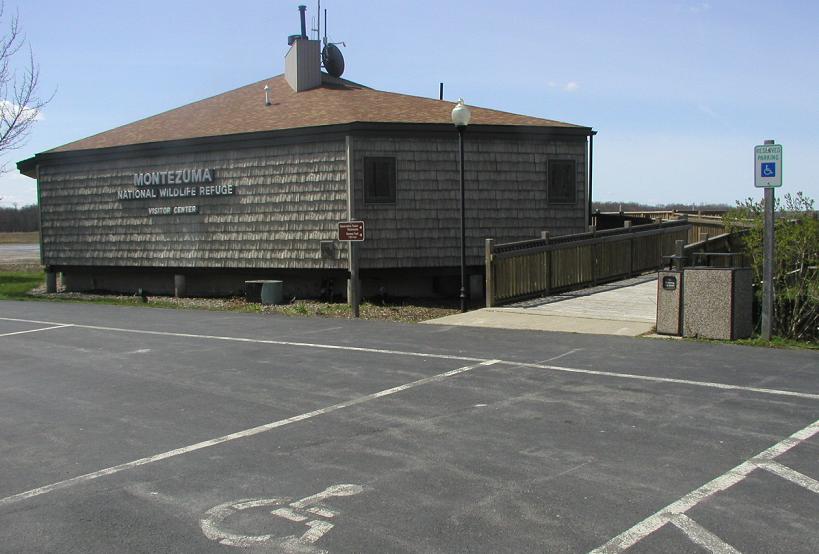
If you are driving across New York state on the Thruway as I was this week, a nice diversion to break up the drive is the Montezuma National Wildlife Refuge near Syracuse, which is bisected by I-90. In an easy hour or so, you can stop in at the accessible visitor center, take a road tour of the refuge with a few stops to view the expansive wetlands, and use the accessible viewing scope at May's Point before getting back on the road.

My timing couldn't have been more perfect in mid-April to hit a nice wave of ducks in migration. It was a glorious sunny afternoon. Tree swallows were cavorting on the wind around the visitor center and checking out the bird boxes. These and the osprey soaring over the center were the first sightings of these two species of the year for me. After a quick pitstop, I took the road tour and stopped at the first open wetland I came upon.

At first glance, there appeared to be zero waterfowl amidst the emerging grasses on a breezy day. With optics, a wide array ducks became apparent. For 20 minutes I oogled over blue-winged and green-winged teal, northern shovelers, northern pintails, and redhead ducks. The redheads were the bird of the day for me. They rarely if ever show up in New England. The males were glossy with water from dunking their heads underwater, so much so that they looked glazed in clear lacquer. Their gold eyes gleamed metallic against their coppery heads. It was a visual feast to take in a selection of ducks in great lighting.

By the end of my diversion, back on the highway, I had added wood ducks, lesser yellowlegs, Wilson's snipe, an American Kestrel, great egrets, ring-necked ducks, mute swans, a bald eagle nest and osprey on the nest to my lengthening bird list. Spring has sprung!


Redhead photo courtesy of photographer Tom Reichner and Ducks Unlimited.

Wednesday, March 31, 2010

Marginal Way, Ogunquit Maine


A wonderful ocean view in Maine - and accessible too! If you've never been to the Marginal Way in Ogunquit, Maine, consider stopping by on your travels or staying for a weekend in this lovely seaside town. My partner Meb and I just returned from a refreshing getaway there and thoroughly enjoyed some spectacular birding. We love this spot especially because we can leave our home mid-day, get there in 2 hours, and enjoy viewing sea ducks on the water in late afternoon sunlight.


Marginal Way is a 1 1/4 mile stroll along a rocky coast. The path is paved and considered accessible, but caution is necessary and the entire length may not be accessible to everyone due to its length and some aspects. There are 39 benches, so plenty of resting space, each with its fabulous view. At the town end, the view includes the mouth of the Ogunquit River and spectacular waves rolling into a sandy beach. At the Perkins Cove end, enjoy a less dramatic but equally scenic view of a peaceful cove and rocky shoreline extending southward. In between the rocky views and waves and incredible expanse are a total mind clearing delight.


The path is narrow. There are some narrow turns and a some spots with a fairly significant grade for a relatively short distance. Someone to assist if needed is a good choice if you haven any concerns. The pavement is generally in good shape, but there are some divets and more disconcertingly, there is in some spots a downgrade right from the edge of the sidewalk, usually just a few inches of downslope, often paved. So you do have to be careful and watch your wheels and footing, despite the accessibility of the pavement. There are few if any handrails, though parts of the path follow private property fences. If you have any challenge with the entrances to the path (supposedly there are no steps but I forgot to double check on the one entrance we used), there are a couple of side street access points that intersect Marginal Way and offer a few parking spaces with easy access to the path. You don't even have to travel any distance whatsoever if you choose, but you may expect wind so dress for the conditions.


I recommend going off season or early in the day at the height of the summer season. Avoid July through September if you don't want to hassle with crowds, narrow streets, and limited parking. We prefer early spring and late fall, when fewer people are around and the seabird viewing is especially exceptional. Sea ducks winter here and if you have binoculars or a scope, amazing views of harlequin ducks, long-tailed ducks, scoters, loons, mergansers and grebes can be easily obtained. Dogs are not allowed between April 1 and November 1, although I assume service dogs are the exception.


Photos:
Ogunquit view courtesy of Maribeth Dawkins
Harlequin Ducks courtesy of Eric Reuter and Ducks Unlimited

Friday, March 19, 2010

Accessible Birding with Joe


Spring is arriving early this year and the birds are on the move! Grackles and red-winged blackbirds are the most recent arrivals in western Massachusetts, following on the wingtips of turkey vultures. The robins have been congregating in my neighborhood all winter. Maybe they knew something all along. Everywhere I go, I'm keeping my eye out for new birds. As we move through spring, birds arrive from the southeastern US early on, then from far flung wintering grounds in Central and South America. Finding such birds can be a treat for the senses and a lovely way to enjoy the outdoors. The yellow warbler shown here in a photo taken by Joe is one of my favorites.


Birding can be an accessible activity, especially if you know of easy access locations where birds gather. One person who knows such places is Joe Superchi of Athol, Massachusetts. Joe is an avid birder who uses a wheelchair. He is a member of the Athol Bird and Nature Club and the Millers River Environmental Center. Each month Joe goes on an accessible birding adventure in the Athol area, as part of a public program offered by the Millers River Environmental Center. Athol is in north central Massachusetts between Greenfield and Gardner along Route 2. You can join him on the second Tuesday morning of the month from April through October and bird from 8 - 10am.

For close up viewing, Joe uses his scope on a tripod or his binoculars mounted on a monopod. The monopod is a great piece of equipment, essentially one leg of a tripod, that allows people with balance issues, hand tremors, weak grip or arms to use binoculars more easily and get more satisfaction out of their sightings. Not all binoculars mount onto monopods, so be sure to ask about this feature if you are shopping for optics. Joe's binoculars and monopod were made by Brunton, a well-known sporting goods company.


To bird with Joe, you'll need your own optical equipment. Several local birding experts drop in on Joe's program and can assist you with spotting. Programs meet at the Millers River Environmental Center in downtown Athol and provide an accessible van for group transport to a selected location. Give them a call at 978-248-9491 to sign up!

Sunday, October 25, 2009

Birding with Jerry - A Blind Date


A glorious May morning after 10 days of rainy weather matched the calendar date I had made with a friend to go birding. We met at Broad Meadow Brook Wildlife Sanctuary in Worcester, a long drive for me but the ideal meeting spot for Jerry, who is blind and lives nearby. Jerry arrived by taxi cab and after a brief discussion about the catbird singing near the parking lot, he took my arm and we ventured onto the sanctuary trails.

Leaves were popping out in the tall trees all around us, about halfway to full canopy, so I still had a chance to see many birds. Almost immediately as we headed down trail a scarlet tanager began to sing. We stopped to listen. "Have you heard the scarlet tanager before?" I asked Jerry. "Just on recordings’, he replied. "I think of it as a robin with a sore throat. It also has a ‘chip - bur’ call too, doesn’t it?"

"Yes," I answered, and within a few minutes, the distinctive chip-bur call began high overhead. As we continued our walk, we heard several scarlet tanagers singing and calling throughout the riverside forest. We also heard rose-breasted grosbeaks and robins. All three birds have similar songs and offered us the chance to compare and contrast. Jerry hadn’t heard the rose-breasted grosbeak live before either. "This one," he said, "I think of as a robin who has taken singing lessons." His references come straight out of Peterson’s field guide text, which provides handy ways to identify and remember some bird songs. As we stood and listened, a scarlet tanager flew down to eye level and dazzled me with a view of its electric red body and black wings. I had to remember to keep breathing.

Several other birds began to make themselves known. An ovenbird pumped out its "teacher teacher teacher" song. This was a warbler that Jerry had encountered before. As we passed near it, we stopped so Jerry could make a recording. He had brought a large microphone designed for capturing bird sounds which fit easily into his jacket. He also wore to microphones clipped to his cap, each one near an ear, for a more dimensional sound effect.

The sun filtered through the tree tops and we navigated a rocky stream crossing. Jerry held my arm just above the elbow and followed a half a step behind me, feeling how I was moving and following suit. I offered occasional comments on the level of rocks along the rocky passage, the mud puddles we were side stepping, and low hanging branches. It turned out to be quite easy to be Jerry’s sighted guide even on complicated terrain. Having been blind since birth, Jerry is adept at moving through his environment with guide dog, cane, or human support.
Orioles were calling throughout the forest too. Although we were hoping to hear a great crested flycatcher, we only heard orioles giving short phrases that sounded similar to the flycatcher’s voice. We stood still a few times, trying to decide who the real singer was, until the oriole would sing a longer phrase or move into view and reveal its identity.

Deciphering mystery singers on the spot can be difficult. Being able to find the singer visually and observe it singing is the ultimate clear identification. Relying on memory can be misleading. Some birds sing a consistent phrase or have a truly distinctive voice that can be remembered from year to year. Others have such a wide variety of vocalizations that it may take awhile to sort out and some songs may never move beyond mystery status.

An American redstart, a showy orange and black warbler, landed on a branch above and peered down at us. I let Jerry know the bird was there, but its silence gave him no way to perceive it. We continued along the trail a short way and were riveted by a mystery bird that was singing from one hidden spot high up in the half leafed trees. No matter how I repositioned myself along the trail I could not find the bird in my binoculars. The song varied a lot but we both agreed it had to be a warbler. One phrase was an ascending burry emphatic trill, another was a choppy series of notes with the same tone. Was it a blackburnian warbler, cerulean warbler, or the American redstart? In migration many birds are possible even outside of their breeding habitat. Jerry recorded the singer to compare to recordings on CD at home and we continued uphill to some power lines. Here we had the satisfaction of hearing the blessedly consistent and easy-to-identify trill of the prairie warbler, a new bird for Jerry.

All around us on this May morning birds were singing and calling. Wood thrushes, American goldfinches, yellow warblers, common yellowthroats, tufted titmice, grackles, cowbirds, and red-winged blackbirds could also be heard. After awhile the brain rebels against focusing intently on so much audio input. "I know we heard that earlier. What was that?" I asked Jerry."I don’t know," he admitted. "All these songs are suddenly cancelling each other out." "Yeah," I answered, "I think we’ve reached overload." "I’m glad I’m not the only one!" laughed Jerry, as we headed back to the visitor center.

Jerry can often be found at the Broad Meadow Brook visitor center on Saturday mornings. He birds from the deck and talks with visitors, sometimes confirming identifications through their eyesight. He welcomes the chance to walk with others on the trails of the sanctuary, whether you are an experienced birder-by-ear or want to get started. Jerry posts recordings on line at
http://www.townisp.com/~jerry.berrier

A few days after our walk, Jerry emailed me with his identification of our mystery singer. In his email he attached a brief recording from our outing plus a clip from a bird song CD. There was no doubt about it. We had heard a northern parula warbler singing a joyous solo on that spectacular day.

Location: Broad Meadow Brook Wildlife Sanctuary, 414 Massasoit Ave, Worcester, MA
508-753-6087 http://www.massaudubon.org/ bmbrook@massaudubon.org

Fees: Massachusetts Audubon members, free; non-members $4 adults, $3 children/seniors.
Wheelchair accessibility: Visitor Center is wheelchair accessible. Trails from the visitor center head downhill and are challenging and not advised without support. The North Link trail nearby is wheelchair accessible and offers views of the brook. A bird blind near the visitor center is in progress towards complete accessibility and plans are in the works to make more of the trail system accessible.