Showing posts with label downhill skiing. Show all posts

Friday, January 25, 2013

Ski and Play Hockey with Nancy!

Is there someone in your community who excels at helping others have fun? In any community there are usually fun-loving individuals who often work hard to raise the quality of life for those willing and able to participate. In the realm of adaptive recreation in western Massachusetts, one such individual seems to rise above all others in the endeavor to create fun for everyone - Nancy Bazanchuk.


Nancy and a young friend at a recent adaptive
skating program in Holyoke.
I've known Nancy since 1995 when she attended one of our very first adaptive rowing programs on the Connecticut River. When I asked her if she needed assistance to get into a rowing shell, she politely answered "No thanks!", then cartwheeled out of her wheelchair onto the dock, ambled over to the boat and got in, forever changing how I perceived people in wheelchairs. Over the years we've collaborated on adaptive cycling as well as witnessed and promoted each others programs year round.

Nancy and Marcy skate together
keeping an eye on participants.

I spoke with Nancy last weekend at our adaptive skating program in Holyoke and she reminded me that she just wants to make sure that people today get the same great opportunities to play that she has had. Her monthly newsletter from the CHD (Center for Human Development) Disability Resource Program, where she works in Springfield, offers an astounding array of opportunities.  Wheelchair basketball, power soccer, dance, bowling, goal ball, and swim lessons are just some of the regular activities. In winter she also manages two sled hockey teams and organizes downhill skiing trips. Year round she has a limited selection of adaptive recreation equipment (handcycles, skis, beach wheelchair, etc.) that can be rented for those who would like to recreate on their own.

Nancy inspires me through her deep community connections. She seems to know everyone personally and links people to each other and new possibilities continuously. People who come to her programs return again and again. This level of personal commitment to others over many years truly enriches the quality of life for everyone, for the whole community. Thanks Nancy - for all you do!!!

If you live in western Massachusetts and want to get out and have fun with Nancy, here are two winter opportunities not to miss!

Downhill Skiing - Join an upcoming trip to Mount Snow in West Dover, VT or at Pico in Killington, VT. The program includes all types of adaptive skiing, with equipment provided by either Abilities Plus (Mount Snow) or Vermont Adaptive Sports and Ski (Pico). The group carpools to the location, then skis for the day with a one-hour lunch break. $55 per person covers the lift pass, ski rental and instructor. Family members and friends are welcome to ski but the cost may vary for them. Upcoming dates are February 17 at Pico, March 3 at Mount Snow, and March 17 at Pico.

Sled Hockey - The Western Mass Knights are an adult team and the Springfield Sliders are a junior team. Both teams practice at the Amelia Park Ice Arena in Westfield, where a major sled hockey tournament takes place in April with teams from all over the Northeast. Nancy is always looking for more players for this fast-paced growing sport, and you don't have to have disability to qualify. Junior players are especially needed for the second half of this season!

You can reach Nancy at 413-788-9695 or nbazanchuk@chd.org

Friday, December 28, 2012

Adaptive Downhill Skiing Basics

Thanks to Chauncey McCarthy for this rundown on one of the most exciting adaptive sports of winter! Thanks to New England Disabled Sports for their photos and thanks to Posie Mansfield for her photo three track skiing! With these contributions I now have a good grasp of the basics of adaptive downhill skiing.


Downhill skiing is a great way you can enjoy the winter outdoors! If you like the exhilaration of speed, open views of mountains and clean crisp air, consider trying out an exciting new adventure on the slopes! It’s a wonderful opportunity to master a new set of skills and enjoy a colorful community of thrill seekers amidst spectacular scenery! With well-developed equipment and instruction, adaptive skiing has a growing presence at many major ski resorts, serving a large range of people (kids included!) with different types of disabilities.
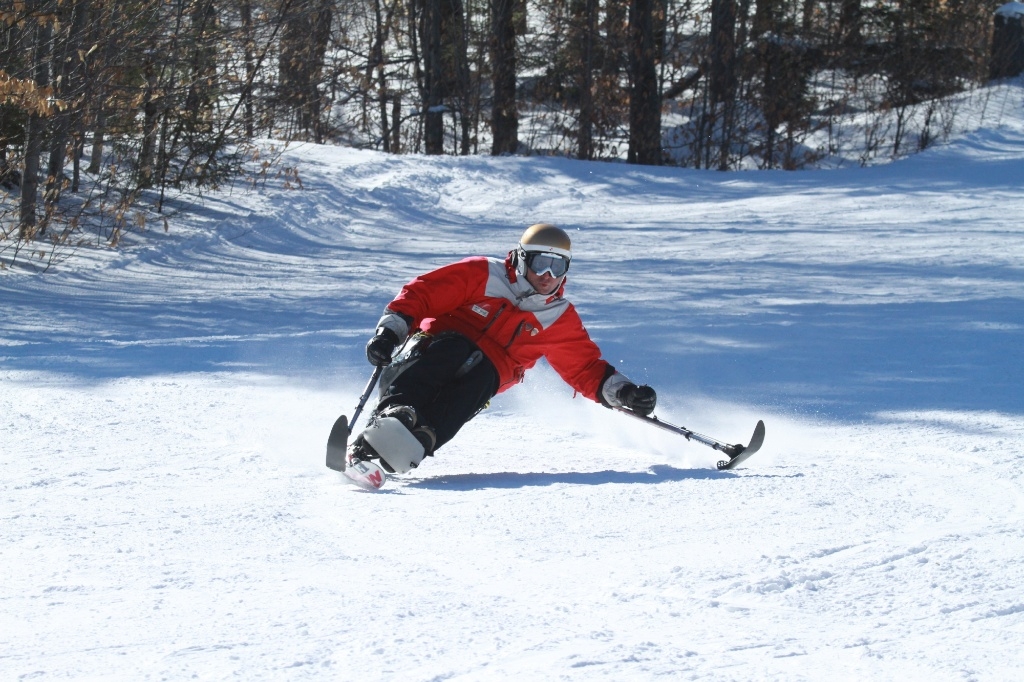
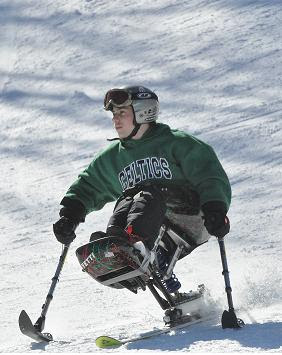
Seated skis are a primary mode as well as the standard image of adaptive skiing. Sit skis work well if you have a spinal cord injury, lack of balance, or inability to stand. Sit skis come mainly in two design styles - the mono ski and bi ski. Sit skiers and adaptive ambulatory skiers use outrigger poles - forearm crutches modified with a ski tip bottom to help maintain balance and initiate turns.

A bi ski is the right choice if you have limited trunk control and some upper body strength. This sit ski has a large bucket seat mounted to two skis directly underneath the seat with limited suspension. Fixed outriggers can be used to increase stability. The instructor can tether into this ski to control the experience of the skier who may be passive or participate to the level of their ability.

A mono ski is a great choice for someone with trunk control and upper body strength. This sit ski has a bucket seat mounted with a suspension system to one ski. It can be self loaded and allows for a complete independent skiing experience once the skier had learned how to fully control the ski. With a lower center of gravity, sitskiers really fly downhill!

If you are ambulatory, adaptive skiing is achieved through three and four track skiing. These terms refer to the number of tracks left in the snow by a skier. Three track skiing is when a skier is using one ski and two outrigger poles, or two skis and one outrigger pole. Four track skiing is when the skier is using two outrigger poles and two skis.

For someone with limited leg strength or balance a device called snow slider can be used. The snow slider is essentially a walker attached to a pair of skis - outriggers can be added to increase stability and a tether can also be used by a support person.

Two track skiing for those who are blind or visually impaired is accomplished with tethers, verbal commands and other methods. A blind skier and sighted guide ski together wearing designated vests so others on the ski slope are aware of their presence. Instructors may use other skiing aids during the lesson to help increase the experience.

Many adaptive ski programs also serve youth and adults with autism and other intellectual disabilities, modifying instructions and stimulating influences to the best of their ability to allow for a more successful learning experience.

Several ski resorts in the New England area offer adaptive downhill skiing. Feel free to contact them if you have more questions and want to give it a try!

New England Disabled Sports offers adaptive skiing lessons at Loon Mountain (Lincoln, NH)
Ability Plus offers adaptive skiing at Mount Snow (West Dover, Vermont) and Attitash (Mount Washington Valley, NH)

New England Handicapped Sports Association runs adaptive skiing at Mount Sunapee, NH

Stride Adaptive Sports provides adaptive skiing lessons at Jiminy Peak Ski Area (Hancock, MA)

Tuesday, February 23, 2010

Winter Paralympics - Watch for Tyler Walker


I recently caught a glimpse of the Winter X Games on TV. The event being shown involved downhill skiing - backwards - and a big jump with a lot of aerial acrobatics including the crossing of skis while upside down - then a backwards landing and continuation of skiing downhill - did I say backwards? - to the finish. The whole thing put the Winter Olympics to shame. Now I understand why the Olympics are adding events like snowboarding with its death defying half pipe event. There is a new revolution going on fueled by a youth culture of daredevil antics. Not being a downhill skier, it took me awhile to catch on.


And I wondered, is there an adaptive version of this?


The answer is yes, although I don't think the backwards event above is happening yet on adaptive skis. At the recent Winter X-Games 14 in Aspen, Colorado, a New Hampshire native, Tyler Walker, took the gold medal in Monoskier-X. This is a competitive race of four individuals over a downhill course fraught with curves and jumps. These cross races are popular in snowboarding and downhill skiing now and are recent additions to the Winter Olympics (though not the Paralympics -yet). It's not just about speed, its about skill and ability to stay upright and in motion in relation to three other competitors flying down the mountain.


Tyler Walker, now 23 years old, was born with very little spine. Both legs were amputated at age four. Despite great excuses to never consider becoming an athlete, he began downhill skiing in adaptive programs in high school. Tyler graduated from the University of New Hampshire recently with a dual major in International Studies and Geography. His academic pursuits tie in nicely with his current endeavors as a skier traveling a world circuit. You can watch Monoskier-X and Tyler's gold medal win on video at his website http://tylerwalker.org/. His entertaining blog also provides a glimpse of the life and travels of a champion adaptive athlete.


Tyler also competes in slalom and giant-slalom. He won the World Cup Championship in downhill last August at the World Cup Finals in Whistler, British Columbia. Watch for news of him at the Winter Paralympics next month where he will compete on the same mountain. He is a favorite to win. Check him out on YouTube as a child on home-made adaptive skis and training for Vancouver at http://www.youtube.com/watch?v=PLE0s_GrI7E

Friday, February 19, 2010

Mt. Wachusett Adaptive Offers Downhill Skiing in Massachusetts


It's not too late to experience adaptive downhill skiiing this year in Massachusetts. Mt. Wachusett is centrally located in Princeton and has had a well-established adaptive program since 1984. Skiing will continue through March seven days a week, weather and conditions permitting.


I recently stopped by on a busy Sunday. The place was a rainbow of color and movement with some 3000 people filling the resort, the grounds and slopes on a bright sunny afternoon before the Super Bowl. Seven hundred people had just finished a race. I felt like I had just discovered where everybody goes in the winter.


I found my way to The Learning Center, where Mt. Wachusett Adaptive is based. There I met "Adapt Dave", the first person I've ever met who has built a new name for himself out of such flexible terminology. Though Dave Domke is retired, he now works full time at the ski resort serving skiers with disabilities along with a crew of about a dozen specially trained instructors.


The program is affiliated with AbilityPLUS, an adaptive recreation organization based in New Hampshire that provides expertise and fundraising opportunities to ski resorts serving people with disabilities . Their home base is Waterville Valley, NH and they both operate and support adaptive programs at several other ski resorts in New England. Mt. Wachusett Adaptive serves about 250 individuals in a season and provided 300 lessons last year. The benefit of putting up with crowds at Mt. Wachusett is that their rates are lower than many places further north. The Learning Center also offers some additional discounts. Go during the week and take full advantage of fewer crowds in a convenient location for southern New England.


"About 70-80% of our skiers are in the autism spectrum", Dave told me, "Many of these are kids with Asperger's Syndrome, since this environment is too stimulating for most of those with severe autism." Indeed, while I talked with Dave for an hour, two kids finished separate ski lessons with the program. They blended in perfectly with the hundreds of other colorful kids milling around outside. Dave showed me an orange and black pole, about seven feet long, used by ski instructors to teach stand-skiers side-by-side how to turn without using ski poles by shifting weight and direction.

For that other 20-30%, some interesting equipment is on display and ready for use in The Learning Center. Monoskis and bi-skis are seated skis with, as the name implies, one or two wider skis mounted below a technical looking, solid seat and frame with various suspension and shock absorbing components.
The lesson book was full on signups, including the Massachusetts Hospital School which brings students on a weekly basis and leaves their own bi-skis on site. Dick Crisafulli, their recreation director, was kind enough to send me some photos of MHS students in action on the slopes. Here you can see the difference between the monoski featured on top and the bi-ski shown below, along with a support skier tethered in who physically controls the ride. Independent skiers who are seated or standing may use the outrigger poles shown in the top photo for steering, balance and braking.
"It only takes four pounds of pressure to turn a monoski," Adapt Dave told me, "so if you can only move your head a few inches, you can turn!" To schedule a session, call Adapt Dave at 978-464-2300 extension 3307.
If you've been skiing with Mt. Wachusett Adaptive or any other adaptive downhill program, let us know about your experience!

Tuesday, February 16, 2010

The Sno-Limo: an unexpected discovery at the Winter Olympics


While lounging on the couch watching events at Day 3 in Vancouver, a special little commercial popped up on the Sno-Limo, a seated downhill ski designed for those who don't ski or snowboard and want to experience the slopes. Looks to be quite a solid piece of equipment, designed for parents or grandparents of skiers and snowboarders, those who have disabilities that prevent them from moving independently, or anyone who wants to try it out.


The seated and bundled rider is "chauffeured" by a standing person who rides the back of the Sno-Limo, much like a kicksled driver but minus the kicking. Looks like a blast and definitely my preferred way to enter the world of downhill skiing! Too bad, but I don't think there are any in New England yet!


Exploring their website, it appears the Sno-Limo has been used only in British Columbia, Canada on a small scale at a few ski resorts since the winter of 2005-6. I'm guessing it has been under development. The website indicates that broader distribution is under way. I made an inquiry, but haven't heard back on where people might be able to try the Sno-Limo outside Canada or how much they cost. How about though - anyone else interested in this new possibility?