Thursday, April 28, 2011

Celebrate the Season by Flying a Kite!

Anyone out there flying kites this spring? We are considering kite flying as a new activity for our REC Connect grant and are seeking information about accessible kite flying. If you have a disability and fly kites, we'd love to hear from you! If you are simply interested in kite flying, we'd love to know!

Kite flying is a colorful, inspiring activity that spans many cultures and dates far back into history. It can be enjoyed alone or with others, typically on an open field or beach where wind conditions are most likely to be ideal. Kite flying open us to the sky and celebrates spirit. The festive presence of kites is a cultural tradition in many places from Afghanistan to New Zealand.

Flying a kite can be as simple and affordable as buying one for $1 and launching it in a city park. Many specialty kites are available and stunt flying with kites on two or four lines has become increasingly popular.

Local clubs and regional organizations such as Kites Over New England (based in Billerica, MA) offer social events, lessons, demonstrations and events.  The American Kitefliers Association has established April as National Kite Flying Month and provides nationwide information. Kite flying aficionados (known as "kiters") may create fanciful homemade creations of substantial size that take as long as a year to build. Kite design has come a long way since I last flew one in my teens as I learned recently from this breathtaking Italian music video.

People with disabilities are engaging with this intriguing pursuit, yet information is scattered as to how and where to go about it. Searching the internet turns up people with disabilities of all kinds who fly kites, including people who are blind, have developmental disabilities, or use wheelchairs. I also found a fully inclusive kite flying events in Australia and India, plus a few examples of kite flying events as fundraisers for disability organizations, most notably one in Africa which promotes mental health and attracts an attendance of 20,000 people. For the more adventurous souls, kite flying can be used to power experiences on other equipment, including carts, surfboards, skateboards and more. Check out the Mobius Disability Kite School in England.

Kite flying in India at a festival.

If you are inspired to start flying kites, the best strategy seems to be to link up with a kiter, presumably through an organization like the ones above, or simply trying it on your own. Kite flying by people with disabilities and others can even take place indoors, without wind, with either miniature kites or a full size BioKite. A young man with epilepsy who is a great spokesperson for the benefits of kite flying flies one on America's Got Talent.

If you'd like to comment on kite flying, please do so here or contact Heidi at 413-577-3840 or heidi.marie-peterson.state.ma.us. We'd love to hear from you! You can also visit us on our facebook page!

Thanks to Wilderness Inquiry for the beach photo and Kites Over New England for 2nd two images.

Thursday, April 14, 2011

SideStix in Action

We finally got to test SideStix today in an urban park in Worcester. Dwayne Boyd has provided us with the first real run on these adaptive all-terrain crutches and the feedback I've needed to assess them for our hiking program. Dwayne is a few months shy of forty and has cerebral palsy. It was his second time testing SideStix. Both times he marveled at the reduced impact on his joints that the shock absorbing design offers.

Last month we took a short walk outside the Buffone Rink before a skating program and tried SideStix on a rapidly melting snowfield still over a foot deep. He was amazed by his ability to float on top of the snow using the snowshoe attachments. Afterwards he said, "With these crutches I could go out in the yard and play in the snow with my kids! I know this product is intended for specialized use, but I would buy them to use everyday!" Since then, he's been working every angle to acquire a pair. Dwayne has written his own account after his first use of SideStix which you can link to here.


Dwayne uses an allen wrench to swap out tips on SideStix.
In today's test adventure we tackled the beach and a gravelly acorn-laden uphill trail, scrambled over a stone wall, ambled through the paved parking lot, and took a short stroll on footpaths to get onto a wooded knoll. Dwayne's mother Linda joined us for part of the time, and treated me to a potent dose of  mother's pride. "I remember the doctor sitting down with us when Dwayne was a kid," she said. "He gave us a list of all the things Dwayne would never be able to do. I'll never forget the day when Dwayne crossed the last one off the list - that one was 'having children'." I was dying to hear what else Dwayne had crossed off the list, but I had to run to keep up with him!


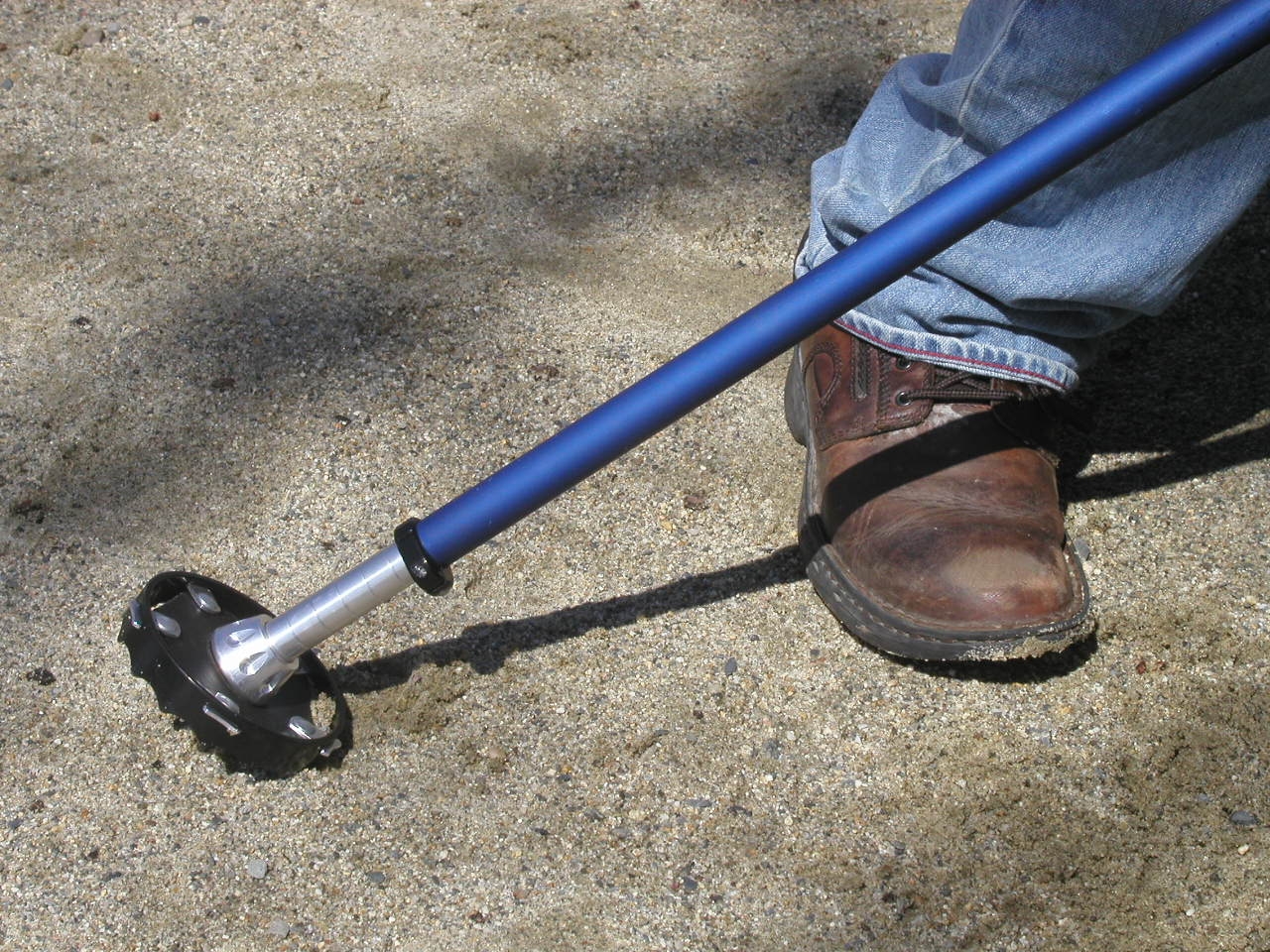
On the beach, Dwayne once again discovered he had better grip on the ground with SideStix. "This would be impossible on my regular crutches," he noted. With the spike and trail basket at the crutch tip, they performed well in both wet dense and loose dry sand. SideStix gave Dwayne more efficient use of his energy - he could travel farther than on his own crutches. He also traveled faster on level ground. The rotating articulating tip gave him more secure contact with pavement and all its irregularities. He found the spike surprisingly easy to adjust to using on the trail.

Dwayne had to give the crutches up briefly to get over the stone wall, took a tumble when he stepped on the trail basket at the crutch tip by accident, and decided not to tackle a steep grade with loose gravel when he met the edge of his comfort zone. Otherwise, Dwayne would have kept going until dark I think. Playing with his daughters at our skating program was on his agenda for the afternoon. Between "sidesticking" and ice sledding, Dwayne should sleep well tonight!

Saturday, April 9, 2011

Summer Camps for People with Disabilities in Massachusetts and Beyond


Camp Arrowhead buddies in the waters of Lake Cochituate.
Photo by Ken McGagh, MetroWest Daily News Staff.
I've been hearing about summer camps for kids with disabilities in Massachusetts and decided to investigate further. Turns out many camps have been around for over 50 years and have well-established communities. It is truly inspirational to scan through their websites. I offer a few descriptions here as a sample of the possibilities.

Camp Arrowhead on the shores of Lake Cochituate (just outside Boston) is sponsored by the Town of Natick Recreation and Parks Department. The day camp serves both kids (age 5 and older) and adults with a wide range of disabilities from late June through mid August. A one week trip to Lion's Pride Camp in Durham, NH offers a residential experience later in August. Camp Arrowhead is open to Natick residents with some spaces available to non-residents. Each camper is paired with a teen companion in what appears to be a very successful community-based support system.
Camp Jabberwocky is a small residential vacation camp for kids and adults on Martha's Vineyard, that originally began as an opportunity for kids with cerebral palsy and has since expanded its audience, serving about 100 campers each year. Activities include dance, community plays, jet-skiing and para sailing, with occasional visitations by island celebrities. Campers and staff are profoundly dedicated.
The Bridge Center offers several summer day camp experiences in southeastern Massachusetts, specifically oriented towards campers with autism spectrum disorders, learning and cognitive disabilities, and behavioral issues. Campers are organized into small groups based on disability similarities and engage in both traditional and therapeutic recreation activities including swimming, archery, horseback riding, and a low ropes course.
Camp Howe in Goshen is over 80 years strong and offers a full range of traditional day, overnight and weekly camp activities on a waterfront with a farm experience adjacent to the D.A.R. State Forest. This is an inclusive camping experience. A program called ECHO works with campers with disabilities separately and mixed in with general campers. Camp Howe is dedicated to cultivating understanding and appreciation of individual differences.

Accessible tree house at the Fowler Center.
I could go on and on! There are many more camps and quite a few specialize in particular individual circumstances such as diabetes or limb differences. If you are seeking information about summer camps this year, link into a one-stop resource on the New England Index website. If you have a camp to recommend here, feel free to comment!

I confess I have unabashedly borrowed these photos in order to help promote the summer camp opportunity for people with disabilities. I also cannot complete this post without mentioning the Fowler Center in Michigan as further inspiration - a unique facility lovingly created by a visionary individual with cerebral palsy that offers an accessible tree house and a camp for kids on ventilators (with medical doctors from the University of Michigan as dedicated staff). Perhaps we have an equal here in New England - my research ends without revealing this possibility.

Friday, April 1, 2011

Jump-start Recreation Opportunities April 5

I'm back from vacation and looking out the window at an April Fool's day snowstorm! Perhaps you too are still half in winter and half in spring mode. There is no better time to consider all the possibilities! The Gaylord Hospital in Wallingford, Connecticut is once again offering their annual Day of Discovery on Tuesday, April 5, from 5:30 to 8pm. It is a fantastic bull's eye opportunity not to miss.


"Every sport! Every season! Everything you want to know! All in one place, one night! Slides! Videos! Equipment! Coaches! Athletes!" sings the poster for this free event. In one evening you'll have the opportunity to learn  about a wide variety of adaptive sports programs offered in southern New England. Meet the people involved, pick up program calendars, and sign up for programs! Activities include golfing, tennis, skiing, archery, sailing, kayaking, sled hockey, curling, adaptive cycling, horseback riding, water skiing and more.

Saturday, March 12, 2011

New Ruling Allows Power-Driven Mobility Devices on Trails

Effective March 15, people with mobility-related disabilities will be able to legally use power-driven mobility devices other than wheelchairs to access trails on public lands. This Department of Justice Ruling has been under consideration for awhile, with much input from the disability community and others. It specifically applies to those entities covered under the ADA (Americans with Disabilities Act). In reading through some of the text of the ruling, I find it admirable to see how well considered the needs of people with disabilities are taken by the federal government, although the new law does not apply to federally managed public lands, such as National Parks. State, local, and private land managers are scrambling now to figure out how to integrate the new DOJ ruling into practice, since it will apply to trails not normally open to motorized vehicles. Areas that have been assessed according to DOJ standards may be exempt from the new ruling.

Five years ago at one of our Universal Access Program events in the Berkshires of Massachusetts, a woman on a Segway using the Ashuwilliticook Rail Trail rolled up to talk to us and demonstrate her new mobility device. It was exciting to see the Segway in use, particularly by someone with multiple sclerosis. The Segway is a good example of a power driven mobility device designed for broad public use, with great potential for some people with disabilities. Other examples include golf carts and ATVs.

Thursday, March 3, 2011

Wheelchair Accessible Maple Sugaring!

Tired of winter? Time to jump start spring and get your taste of a New England Tradition! Sample the syrup as it is being made this month at the following locations and events near Boston.

March 12 and 13  10am - 4pm  Maple Sugar Days at the Blue Hill Reservation in Milton, MA - This annual event is wheelchair accessible! Admission is $6 per person, ages 2 and younger are free. Enjoy the smell of sap cooking down, the taste of the latest batch, a free shuttle ride, and activities for all ages at beautiful Brookwood Farm. DCR and Mass Audubon jointly host this highly popular program. Nearby at Trailside Museum, visit outdoor wildlife exhibits. For more information, please call 617-698-1802 or 617-333-0690.

Wednesday, February 23, 2011

Matt Gannon 1973-2011


Cynthia Yackenchick and Matt Gannon rolling by the river
in Turners Falls.
It is with much appreciation and sadness that I bear witness to the life and passing of Matt Gannon of Erving, Massachusetts. Matt was a participant in Universal Access Programs in recent years who especially enjoyed coming out in winter. Matt served in the US Marine Corps from March of 1993 to May of 1994, when he was honorably discharged after being hit by a car while off-duty and stationed in Japan. Matt suffered traumatic brain injury and was quadriplegic as a result of this accident. His indomitable spirit helped him tough it out in a body that he could not much use for the rest of his life. 


Friday, February 18, 2011

Upcoming Events Last Week of February


Try sit skiing, snowshoeing and more at Wendell State Forest!
Don't let winter melt away without planning an end of February Winter Blast! Here's a mix of exciting opportunities for the last week of February in New England!

DCR's Universal Access Program:
Outdoor Recreation at Wendell State Forest, Wednesday, February 23 and Saturday, February 26 - Join us for the last 2 winter program in Wendell, a rural town in western Massachusetts located 20 minutes east of Greenfield. Here's your chance to enjoy as many activities as conditions permit: snowmobile ride, ice skating, kicksledding, cross country skiing, and snowshoeing! 11am - 3pm. Call All Out Adventures at 413-527-8980 to register.

Mike Hanson FInds a New Job While Hiking

Mike hikes in the snow as well as during summer months!
Last June I wrote a post about Mike Hanson, a blind man from Minnesota who was through-hiking the Appalachian Trail to raise awareness about the abilities of blind people. He was testing a method of using GPS (global positioning system) to aid navigation for blind users in challenging terrain. Mike was recently featured in local Minnesota news for his ongoing achievements.

Mike completed 1700 miles of the 2174 mile trek, hiking from March into October, enduring all the hardships every hiker takes on - steep grades, narrow rocky paths, dropoffs, mosquitoes, bears, wind, extreme weather, thunderstorms. His GPS system, which he spent two years designing, worked fairly well on the trail, but also slowed down his time relative to the pace of sighted hikers. He and Gary Steffens, his trail companion who filmed the journey, also relied on a conventional map to navigate. Though the prototype technology was not fully reliable for the complexities of mountain trails, the two men discovered that they had a unique tool in hand for overcoming significant navigational challenges that blind people face everyday in ordinary life.

While on the trail, Mike received a phone call from a businessman in Minnesota, who offered him a job - to develop real time navigation for people with visual impairments. Mike accepted the offer, ending his hike short of his original goal, but fully succeeding in his mission to raise awareness of the capabilities of blind people and adaptive technology. His patron is now seeking funding to make Mike the CEO of a brand new company.

You can read more about Mike's story in greater detail here, including further description of his time on the trail and the navigational system he plans to develop. Go Mike!

Wednesday, February 16, 2011

Urban Skating Outdoors!


Bay Cove Day Habilitation joined us on the ice for a variety
of spontaneous games.
Tuesday was ccccccccoooold and winddddddddy but we squeaked in an outdoor skating session at the Kelly Rink in Jamaica Plain with a few playful souls. What is it about the cold? I admit I was reluctant to get out of bed this morning, yet once on the ice in that crazy wind, I wasn't the only one who warmed up quickly! Smiles abounded as everyone became energized in play. There is an added spirit of adventure in braving the elements and finding you can be comfortable and enjoy yourself. Of course, hot cocoa helps too!