Thursday, May 31, 2012

Summer Opportunities with Northeast Passage!

RECREATION OPPORTUNITIES abound with this exceptional adaptive recreation organization!!!! Water Ski on Tuesday evenings! Fee: $20/Session Two locations: Attitash Lake in Merrimac, MA on June 12, 19, July 10, 24, Aug 7, 14 Swains Lake in Barrington, NH on June 26, July 17, 31, Aug 21, 28
Waterski Weekend: Fee: $20/day -- Sign up for one or both days! August 11 & 12 in Mashpee, MA Essential Eligibility Requirement: Participants must be able to turn themselves from face down to face up in the water, while wearing a PFD (life jacket). Instruction on how to do this can be provided. Please contact NEP in advance if you are concerned or have questions.
Disabled Sports USA 'I Can Do Anything' Youth Scholarships Available! The Disabled Sports USA ‘I Can Do Anything!’ Youth Adaptive Sports Scholarship! This initiative provides funding for youth with disabilities (under 18), with limited financial means, to participate in adaptive sports programs. By filling out the application, your child can receive a scholarship for the event registration fees, transportation and lodging costs! This scholarship is good for ANY NEP program between now and September! Contact NEP at 603-862-0070 or northeast.passage@unh.edu to receive an application.
Cycling at Acadia National Park, Maine! Date: June 16, 2012 Time: All Day Ride Acadia National Park in Bar Harbor, ME. Meet NEP there to rent your adaptive cycle and spend the weekend riding the 45 miles of historic carriage roads! NEP Cycle Rental Fee: $25/day. Summer Equipment Rentals! What do you do when you want to play but don’t have the toys? YOU RENT! NEP's equipment rental program makes it affordable to try before you buy, be a weekend warrior, gain skills, and be involved in more than one sport. Best of all, you get the choice and freedom you deserve. What are you waiting for?
Contact NEP to reigster for programs and reserve rental equipment. You can even rent waterskis! Call 603-862-0070 or email northeast.passage@unh.edu. Pre-registration is required for all programs and payment is required at the time of booking to hold your spot. Space is limited, so register soon!

Saturday, May 26, 2012

The Eureka! Freedom Tent

Summer is rapidly upon us and those planning camping trips should know of the Eureka! Freedom tent! Several years ago at a National Recreaion and Parks Association conference in St. Louis, I met Diane Goodwin, the designer of the first camping tent designed with wheelchair users in mind. She was tweaking her final design of the new tent, which years later is still the main option on the market for people with mobility impairments.
Diane put some remarkable thought and innovative design into this product, which received the da Vinci award in 2006 for exceptional design that transcends mandated access requirements. The frame of the two-room rectangular dome tent is self-standing and can be set up by someone in a wheelchair from one side of the tent. The front door has an easy open flap system requiring little effort. The main entrance opens into a front vestibule that allows someone in a wheelchair to fully enter the tent before transferring into an adjacent sleeping area. This extra front room can also serve as a dressing room, dog sleeping area, or additional storage. The sleeping space has rear entry window-doors. Large door and window pulls on the interior make life much easier for campers with arthritis or limited hand mobility.
Blue Sky Designs, Diane's Minneapolis-based design business, teamed up with Eureka!, a well-known tent company, to make this excellent tent available to the public. Technically a two person tent, you can likely sleep at least one child in the front vestibule with a parked wheelchair. The Eureka! Freedom tent retails for $454, but can be found at lower prices online. It's well worth the investment if you are a serious camping couple or small family. The tent is such a great example of universal design that it comes highly recommended for anyone. New Englanders can check it out in person next month at the Adaptive Recreation Fair in Boston on June 9 at the Spaulding Adaptive Sports Center and CapeAble Adventures booth!

Thursday, May 17, 2012

Adaptive Recreation Fair in Boston June 9

Now is the time and THIS IS THE EVENT to discover adaptive recreation opportunities in the Boston area and beyond! Come to Artesani Park along the Charles River on Saturday, June 9 from 10am - 3pm and enjoy a day in the park! Test ride all kinds of adaptive bicycles for adults and kids. Stroll the green, meet adaptive recreation providers and see their equipment on display! Take a short hike in a mountain wheelchair or with a sighted guide! There are myriad possibilities for summer fun to be found here, so don't miss out! This is your chance to do one-stop shopping, meet friendly people and make new connections!
Participating organizations include: Ability Plus All Out Adventures AmTrykeBike-on CAPEAble Adventures Community Boating DCR Universal Access Program New England Disabled Sports Northeast Passage Partners for Youth with Disabilities South Boston Boys and Girls Club Spaulding Adaptive Sports Center Stavros Outdoor Access Waypoint Adventures
Equipment on display will include the Hippocampe, Trail Rider, a wheelchair accessible camping tent, a beach wheelchair, and a sailboat. Facepainting, bubbles, kite decorating and flying (if there is wind!), gentle hikes, letterboxing, and a park quest offer additional enjoyment for all ages. Light refreshments and water will be available. Bring your own lunch and picnic on site! Bring your bathing suit if you want to cool off in the spray pool! Artesani Park is located at 1234 Soldiers Field Road in Brighton. Please call 617-626-1294 to pre-register! ASL interpreters will be on site. This is "not just any day in the park"!

Wednesday, May 9, 2012

Summer Camps: When Severe Disability Is NOT An Issue

Guest Post by Sarah Hart via Phil Dzialo, who writes a bodacious blog called Healing, Empowering and Thriving as a parent of a young man who is disabled. Thanks Phil, for allowing this guest post to be reprinted on Everyone Outdoors! And thanks to Sarah for her terrific work on behalf of kids with severe disabilities at a summer camp in Wisconsin. She reveals what is truly possible! This is a long blog post (and I'm having technical difficulties with Blogger - note there are no paragraph splits!) so start here and continue on at Healing, Empowering and Thriving for the entire amazing story with all the essential tips on how to best find a summer camp that will meet your needs.
Going to camp is a treasured childhood memory for many of us. Nights spent around campfires roasting marshmallows and days filled with activities, anything from weaving lanyards to horseback riding to swimming, glow like fireflies in the back of our minds. Far from behind a relic of the past, summer camps today offer a wide variety of programs, ranging from the traditional (archery, tent-pitching, canoeing, fishing, hiking) to more specialized (computers, photography, ballet). Camp is such a specialized series of events, and such an event in itself, that it may seem that it is specifically designed for campers without special needs. As such, parents of children with disabilities, whether mild or severe, often feel like there is no place for their child in a camp setting.
As a seven-year veteran of camps for kids with special needs, everything ranging from autism and Asperger’s syndrome to Down syndrome to brain injuries to cerebral palsy to rare genetic disorders, spinal cord injuries, involved medical conditions, and muscular dystrophy to hearing impairment and visual impairment, I am here to tell you that not only is it possible for your loved one to attend camp, it is possible for them to thrive in a camp setting. Nike used to use a slogan that I particularly liked: “Impossible is nothing.” While they no longer use it to sell shoes and athletic gear, I still use it when I talk about camps for kids with disabilities. And it’s completely true. Phil wrote a post on his blog earlier talking about how kids like his son Adam, who were basically “nursing home material… save the commitment of (the) parents” and how they’re not the kind of kids who go to camp. Except that every kind of kid is the kind who can go to camp.
At the moment I work at a camp for kids and adults with disabilities in Wisconsin. The particular program I work with is the respite camp, where we accept children, teens, and adults with medical conditions, disabilities, or behavioral problems that make them ineligible to attend most other camps or respite programs. Our program is one-to-one, one camper to one counselor, and our campers range in age from 3 up, with no real upper limit – I’ve worked with campers in their eighties! Our campers have a wide variety of conditions, including autism, cerebral palsy, spina bifida, muscular dystrophy, brain injury, PTSD, Down syndrome, among others. We see campers with severe physical and mental involvement as well as campers with severe behavioral involvement. Our campers vary in the degree of assistance they need - some need little to no assistance with personal care and participation in activities, and others need total assistance for all camp participation and personal care. We have campers with feeding tubes, catheters, Port-a-Caths, tracheostomies and other various "ostomies", brittle diabetes, intractable epilepsy, self-injurious behaviors, DNR orders, and more. We have two nurses on staff during the summer and usually one CNA to accompany them in the summer; during the "off" season when we are only running weekend programs, we have one full-time nurse and usually a second nurse for check-ins on Friday night.
Our camp offers a wide variety of “traditional” camp activities; swimming, cooking over the fire, painting, soccer, volleyball, paper crafts, and community trips, just to name a few. All of our activities can be adapted to any range of function. We have a dance every week, and everyone goes on an overnight camping trip, sleeping under the stars at one of our lovely campsites, set back into our 400-acre forest; natural beauty is everywhere. In addition to the traditional camp activities, we offer a high-ropes course, a travine swing, and a climbing wall with a zipline. The ropes course is set up so that everything except for the high-ropes elements is accessible to campers with physical disabilities. Our goal is to provide a special, fulfilling experience for our campers. If a camper is happiest when observing activities, or walking around camp, we make it happen. If a camper loves all the activities, we encourage them to participate to the highest degree. If a camper is unable to sit in a wheelchair for an extended period of time, we improvise. Some campers hang out on blankets or beanbags; others may bring their own positioning chairs. No matter how they are positioned, our campers are always in the middle of the action. Our one-on-one setup guarantees it. It is my belief that camps for kids with disabilities are an extremely valuable resource. Camps provide breaks for parents and caregivers, while at the same time providing new experiences for campers. Campers have the opportunity to make friends, try new things, and have adventures. Camps provide the kind of experiences you want to remember.
Here is just a short list of the potential experiences available at camps for kids or adults with disabilities: cook outdoors; write songs or poetry; identify birds by their calls; canoeing; tour a local monument or museum; archery; put on plays; camp out in tents; swimming; sculpting clay or stone; play Earth Ball, soccer, hockey, tennis, baseball, or volleyball; build models; tie-dye, tandem bike trips; games like tag or relay races; attend concerts or other live performances; play instruments; pontoon-boating or paddle-boating; group sing-a-longs; murder mystery evenings; purchasing items from the camp store; campfires; and spending time on high or low ropes courses. And that may just be the beginning. Remember when I said that I loved the slogan “impossible is nothing”? Well, it’s true. Throughout the seven years I’ve been working at camps for kids with disabilities, I have been witness to many things that I’m sure most people would find impossible. Here are two examples.
CONTINUE THIS ARTICLE AT HEALING, EMPOWERING and THRIVING! (If it is no longer on the front page, search the title of this post in the search box there.) Lots of great advice on how to shop for the right summer camp experience - DON'T MISS OUT!

Saturday, May 5, 2012

Games and Kites!

Outdoor games and kite flying go well together for an adaptive activities program in an urban park setting. Kites have universal appeal, adding a colorful festive element that motivates people to look up and enjoy the sky. A variety of games can offer people options based on interest and ability. Today for our REC Connect program in Worcester all that was needed was a parachute and a selection of soft balls and rubber chickens to offer a fun experience for a small group of people that came out to play. Shouts and laughter from our small group playing parachute games caught the attention of several people walking laps around the track in Lake Park.
With the lightest intermittent wind we were able to get a few kites to lift up off of a big playing field. A little bit of running gave a couple of kiteflyers some exercise and a more sustained flying experience. Small diamond kites are lightweight and allow for easy launching with a light steady breeze, even from a seated position. With increased wind, more types of kites can be flown, with team support if needed. Without wind, more types of games can be played. With both kites and games in motion, more people can be served. Our next adaptive games program will be at Holyoke Heritage State Park in downtown Holyoke on Saturday, May 19 from 1-3pm. For further information and to pre-register, contact Heidi Marie-Peterson at 413-577-3840 or heidi.marie-peterson@state.ma.us. We hope to see you there, and if not, the most important thing is to just get out there (even on a gray day!) and enjoy yourself!

Monday, April 30, 2012

Accessible Gardening Resources

While in Michigan earlier this month, I stopped by an Ann Arbor park to see what was growing in their accessible community garden. Not too much except spinach in a few boxes, which made me wonder why this amazing space wasn't showing more visitation and use. I found raised beds a various heights, for use while standing, sitting in a wheelchair, or sitting on bench walls surrounding a raised bed. Short trellises nearby showed me that vine plants like peas and morning glories could be kept within relatively easy reach.

Gardening is one of my favorite outdoor activities. I love growing flowers, herbs and vegetables. Since I live in the woods, I cultivate flowers and kitchen herbs in containers on the deck where the sun shines for half the day. For full sun growing I help a friend in her garden and reap the abundance of fresh air and vegetables throughout the season. The benefits of gardening include mild to rigorous exercise and social time with others. A hands-on connection to the earth, living food, and nature are also a deep part of the experience for me. I also enjoy a sense of connection to my ancestors, who grew much of their own food.

Seniors and those who have disabilities need not be excluded from this spring time reconnection to the earth. Raised beds and adaptive tools are two popular solutions that help facilitate easier access to the soil. Gardening buddies can do the heavier lifting. With a quick search on line to see what is specifically available, I found Accessible Gardens, a Rhode Island based company founded by Ray LaRoque, a wheelchair user who has "raised gardening to a new level" with portable raised garden structures much like what I found in Ann Arbor.

Other resources available to the budding gardener include basic articles such as those offered by the University of Minnesota's Extension Services, a spinal cord injury support site called Apparelyzed, and garden supply companies such as Natural Yards. There are a few good books on the subject as well - just Google "accessible gardening" on Amazon to find out more.

If gardening appeals to you, now is the time to explore your options!


Tuesday, April 10, 2012

Freedom and Speed

The following is a Guest Post from Alejandra Taco. She is a Nutrition Coach and Founder of Holistic Health Empowerment (www.holistichealthempowerment.com) who has, in the last few years, discovered the fun and health benefits of adaptive recreation through Piers Point Sailing, participating in the Boston Marathon, and DCR's Universal Access Program. Thanks Alejandra, for sharing your words and experience!


Sports to me were for the able bodied. Growing up with cerebral palsy and using a wheelchair meant that sports were not for me. I would tell myself that if I could walk I would have a more active life. That all changed when I got invited to go sailing for the first time.

On my 24th birthday I had the opportunity to sail with Maureen McKinnon-Tucker, a gold medalist in sailing at the 2008 Paralympics in China. It was my first taste of adaptive sports and meeting Maureen opened my world to endless possibilities. The moment we left our chairs behind and got on the boat my perspective of what was possible for me changed. A sense of freedom took over as I experienced the thrill of speed which I love! Watching Maureen sail and be in control of the boat showed me that sports could be part of my life as well. This inspired me to find out what other adaptive sports were out there for me to try.

Growing up in Boston and going to see the marathon each year always stirred something inside me, making me want to be part of it someday. That dream became a reality in 2010! With the support of my family and the guidance of three wheelchair racers I embarked on one of my biggest challenges. With very little training and not much time on my side everyone thought I was a bit crazy but supported me anyway. On May 19, 2010, I raced 11 miles of the Boston marathon. It was an experience that I will never forget showing me what I was capable of.

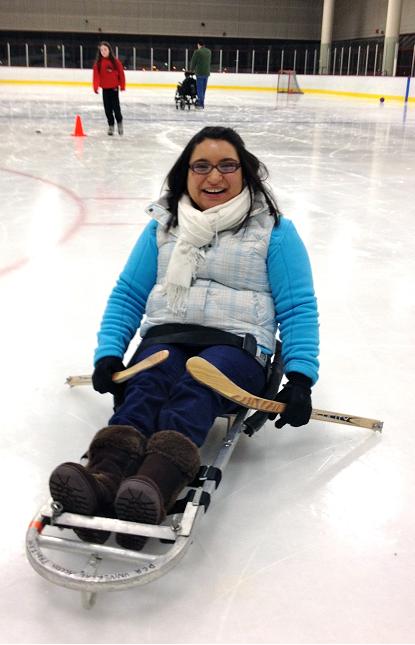
My adventures didn’t stop there, when I found out about DCR’s Universal Access Program and their adaptive skating program in Revere. I decided to give it a try and see what it was all about. Marcy and Heidi welcomed me with open arms, and the next thing I knew I was on a sled with short hockey sticks skating! It took three sessions for me to get the hang of it and I felt free once again, to go as fast as my arms could take me! What I love about the program is the way it connects me with others just like me - people who are looking to feel normal for a day and enjoy themselves. The activities include everyone no matter what your disability is. I wanted to do more so I decided to become a mentor for the program so I could share my experience with others and tell them that sports are for everyone.

As a nutrition and health coach, I help people improve their eating habits and teach the importance of physical activities. Not only do they help us be healthy but they empower us to believe in ourselves and know that we are capable of accomplishing far more things than what society expects from us. Once I leave my wheelchair and transfer to a boat, a racer, a sled skate, or a sit-ski I leave the cerebral palsy behind and feel like any other athlete.

My next stop was skiing and once again I fell I love with it! Brenda from Outdoor Access greeted me with a funny hat and a big smile. She helped me into a sit-ski and taught me all I need to know about skiing that day. With the help of great volunteers I took to the snow at the Weston Ski track. I’ve been skiing two years now and it’s the best part of my winters. Another great thing about these programs is that you don’t need to have any prior experience or skills, all you need is to show up, and they will take care of you by adapting to your needs. The important thing is to have fun, and if you fall try, try again.

In Universal Access programs I skate, ski, hike, sail and much more. In the end I didn’t need to walk to enjoy sports and the thrill of speed. All I needed was to meet the right group friends and mentors and the right toys!

Thursday, April 5, 2012

Abilities Expo In New York May 4-6

The Abilities Expo is a national trade show event that showcases assistive technology in major cities and is dedicated to improving the lives of people with disabilities. For the past 30 years, Abilities Expo has opened new doors for people of all ages with all kinds of disabilities, their families, health car providers and service professionals. The event offers the latest products and services relating to home, auto, travel, health, fashion, sports, recreation and more. The 3 day trade show is held in Atlanta, Chicago, Houston, Los Angeles, and New York each year.

These FREE events feature workshops, demonstrations, assistive technology and retail pavilions. In recent years the Abilities Expo has expanded its offerings to include career fairs, artists markets, performances, animal demonstrations and people with disabilities as ambassadors to link local folks to the regional event. If you haven't been to one in awhile, you might be surprised. It looks like a fantastic opportunity. I've been to locally organized assistive technology expos and they are wonderful community events where new connections thrive. Such an event on a regional scale could have a whole lot more to offer. One benefit is that there are great discounts for attendees on products.

This year's Abilities Expo in New York is coming up May 4-6 at the New York Metro in Edison, NJ. Some of the highlights for this particular show include wheelchair dance performance and workshops, quad rugby demonstrations, assistive dog demonstrations, and the Horse Boy method of working with kids with autism.

I got intrigued by this last entry, never having heard of the Horse Boy. Turns out The Horse Boy is both a book and a movie chronicling one family's journey with a son with autism and how working with horses improved his ability to communicate. From their backyard to Mongolia and back, they pioneered a new dimension to therapeutic riding now known as the Horse Boy Method, which helps those with neuro-psychiatric disorders improve their lives. Demonstrations will be offered by Allie's Kids, a horse riding stable in New Jersey that specializes in working with kids with disabilities and their siblings.

Adaptive recreation and sports organizations presenting in New York this year include Freedom Concepts (adaptive bikes), KEEN (Kids Enjoy Exercise Now), SATH (Society for Accessible Travel and Hospitality), Action TrackChair (all terrain wheelchair), and Journey Forward (SCI exercise program). There are many more - check it out!

Thursday, March 29, 2012

Walking on the Wild Side at Rachel Carson NWR

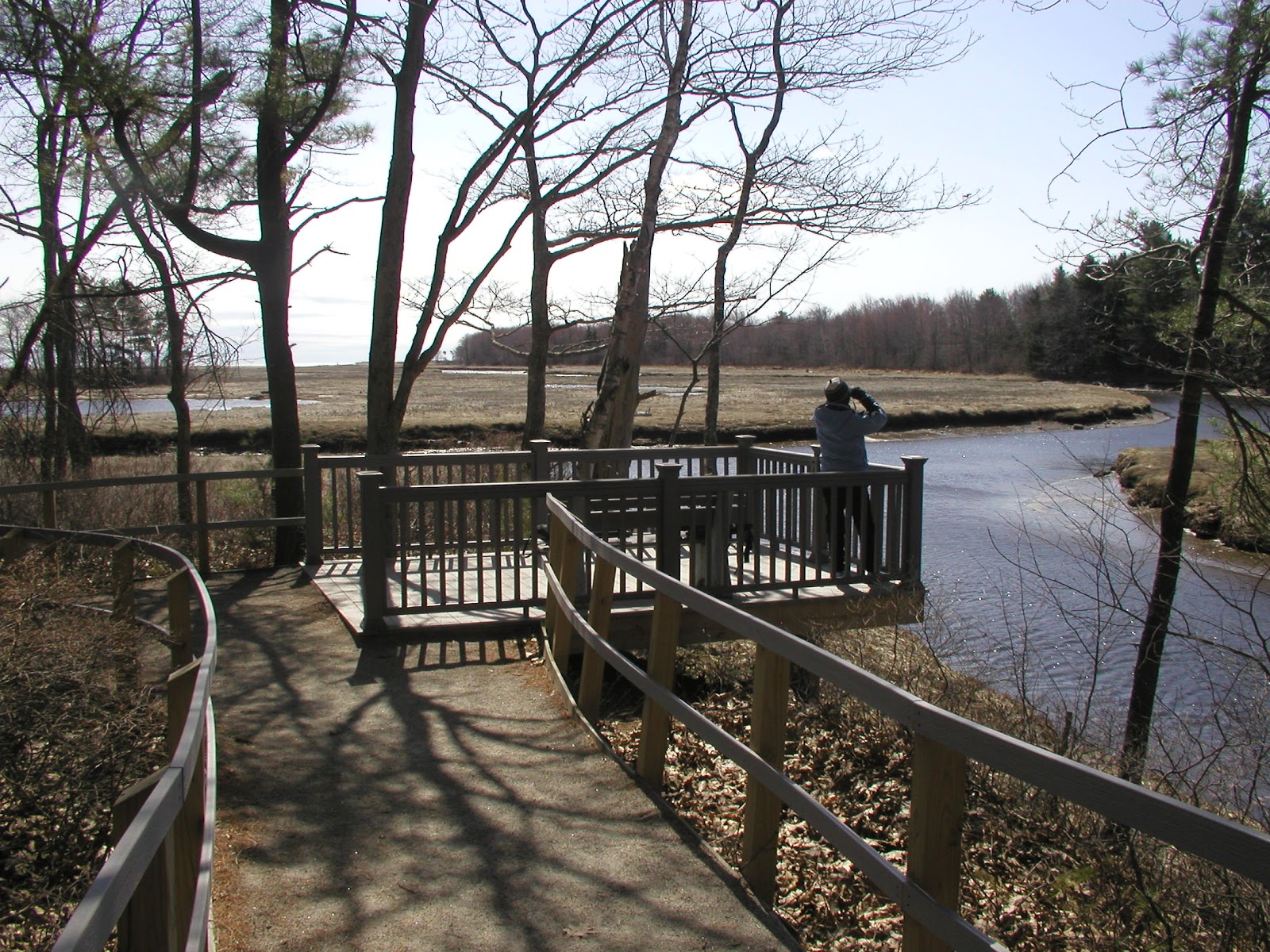
Just returned from a few days in Maine where I checked out the Rachel Carson National Wildlife Refuge in Wells and discovered a beautiful accessible nature trail. If you are looking for a dose of nature by the sea, this is a great place to view birds and wildlife. My partner Meb and I enjoyed the trail on a very windy day, so our sightings were limited to a few pairs of Canada geese, windblown crows, and a newly arrived phoebe with a huge bee in its beak. Having explored the Landholm Farm property adjacent to this one on other excursions, we can vouch for otters in the river and marsh hawks over the wetland. One of these days we'll have to go back for the rich experience of May, when bird migration is in full swing.

The trailhead with a modest visitor center is located on Old Port Road, just off of Route 1, where a sign indicates the refuge nearby. Its a shaded trail in and along a forest edge made of packed stone dust with side boards. The mile long trail travels the edge of the salt marsh in a big loop, with stunning views of the surrounding wetland and a river heading to the sea, which is visible at a distance. Eleven stations along the self-guided path offer numbered stops, most of which are viewing platforms with spectacular views of the meandering marshland and river. If you bring the trail brochure from the box at the parking lot, you can read about natural highlights at each stop.

The trail is in great shape, but be aware that several of the platform edges have experienced slight erosion so if you are using a wheelchair, there is a minor threshold-like bump up onto the deck in some spots.  We met some locals who said the trail gets submerged quite a bit in winter and that the other three seasons see regular use by people with disabilities. Other trail users reported seeing an exceptionally large otter.

If I lived nearby I'd be visiting there a lot.The place is a real tribute to Rachel Carson, whose writing made the complexities of ocean science understandable to the general public in the 1950s. Her controversial book Silent Spring, in which she exposed the threats of pesticide use to the natural world and humankind, launched a new era in conservation 50 years ago. Her courageous educational efforts inspired a public outcry that lead to the banning of the pesticide DDT and saved many bird species from extinction. Something to appreciate when listening to the songs of robins in your neighborhood this spring - or taking a walk on an accessible trail!

Friday, March 16, 2012

Spring Into Cycling with Northeast Passage

Spring is springing so early this year! The weather is already great for cycling. I've seen people out on bikes everywhere I go and am looking forward to getting out on my bike this weekend.

If you are looking for adaptive cycling opportunities in New England, Northeast Passage is one of the best organizations around for cycling expertise and experiences. They offer a great selection of quality handcycles and recumbent bikes, including tandems and bikes for kids. Most, if not all, of their staff are certified therapeutic recreation specialists. Over the years I have always been impressed by their ingenuity and ability to support people with physical disabilities in competitive sports and amazing adventures, including summit hiking in the White Mountains.


Northeast Passage offers cycling clinics and rides throughout spring, summer and fall. Coming right up Saturday, March 24, is an Introductory Cycling Clinic in Durham, NH - a perfect chance to jump start into spring and try out a variety of bikes to see what works best for you. They'll have Top End and Quickie handcycles; Greenspeed, Hase and Trailmate foot-powered bicycles; tandems; and the new Lasher ATH handcycle designed for off road riding. This is a rain or shine event - indoors or out depending on the weather. The $20 fee is well worth it for the expertise and variety of quality bikes involved. Families and friends are welcome!

There are a couple other chances to ride with Northeast Passage coming up this spring. They will do another introductory cycling clinic in Cheshire, CT, on May 12 in conjunction with the Gaylord Sports Association.  

Northeast Passage will also host a clinic on Cape Cod with Spaulding Rehabilitation Hospital and CapeAble Adventures in Sandwich on May 19, followed by a ride on the Shining Sea Bike Path on May 20.

To find out more and sign up, contact Northeast Passage at 603-862-0700 or northeast.passage@unh.edu

Thanks to Dave Lee and Keely Ames for photos!